✦
Series: Behind the Brand
Featured Brand: Airbnb
Published by Entrepreneurship Cell, KITS Akshara Engineering College
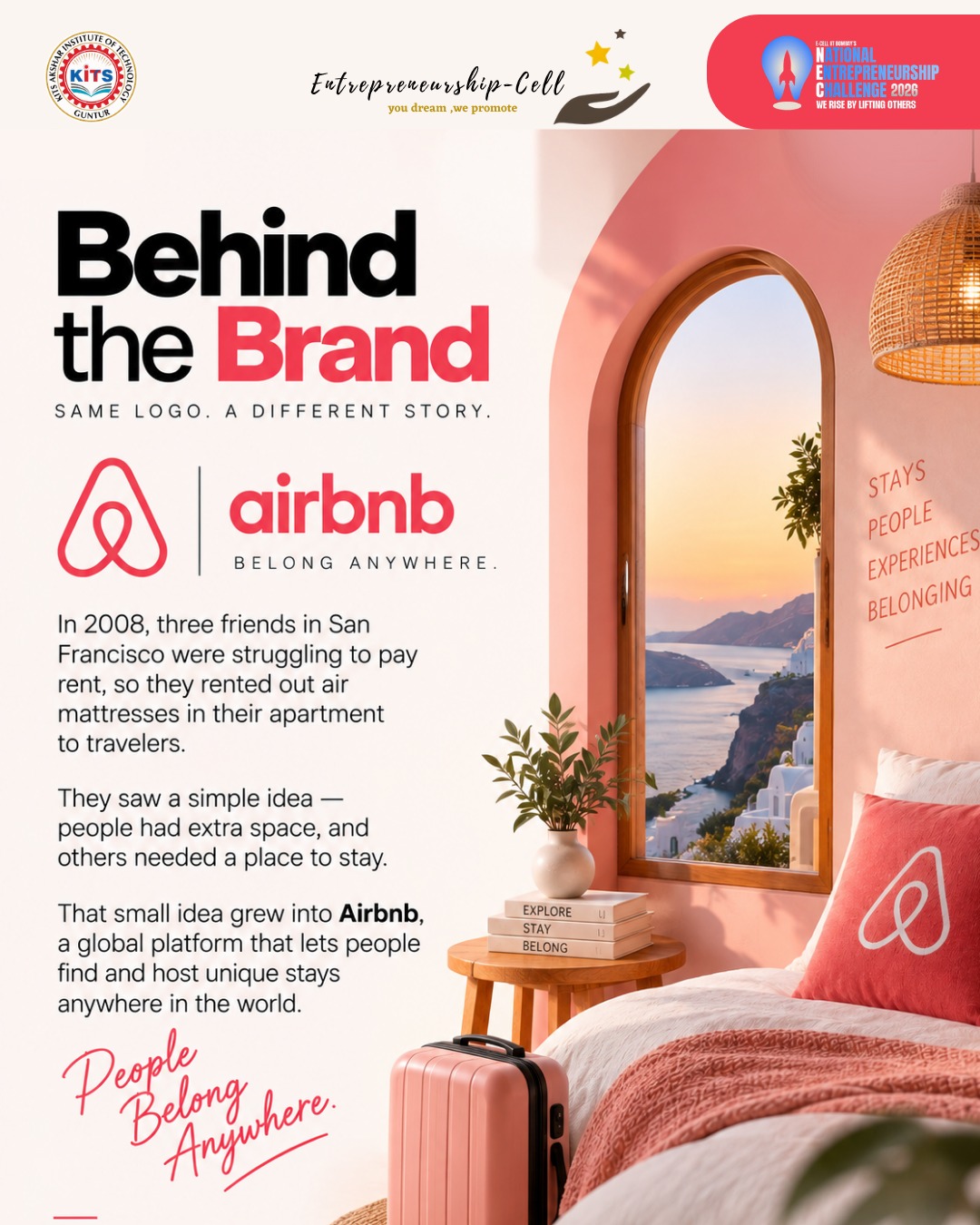 Official Poster
Behind the Brand
Airbnb
Same Logo. A Different Story.
Every successful business begins with an idea, but not every idea begins with a
business plan. Sometimes, it starts with a simple problem, a creative solution, and
the courage to try something different.
The story of Airbnb is a remarkable example of how an ordinary challenge can become
the foundation of a global business. What began with three friends trying to earn money
to pay their rent eventually transformed the way people travel, stay, and experience
destinations around the world.
📍 San Francisco (2008)
👥 Brian Chesky, Joe Gebbia & Nathan Blecharczyk
💡 Ordinary Challenge to Global Business
⏱️ 5 Min Read
💡
The Beginning of a Simple Idea
In 2008, three friends in San Francisco — Brian Chesky, Joe Gebbia, and Nathan
Blecharczyk — were looking for a way to manage their financial challenges. When a design
conference caused local hotels to fill up, they noticed an opportunity.
They decided to rent out air mattresses in their apartment to travelers who needed a
place to stay. This small experiment was built around a simple observation: some people
had extra space, while others needed affordable accommodation.
What appeared to be a temporary solution soon revealed the potential for something much
bigger.
🚀
From Air Mattresses to a Global Platform
The founders recognized that their idea could address a wider need. Instead of limiting
accommodation to traditional hotels, why not create a platform where people could
offer their homes, rooms, and unique spaces to travelers?
With this vision, Airbnb began developing a new approach to hospitality. The platform
connected hosts with guests, allowing people to discover accommodations that offered
experiences beyond conventional hotel stays.
Over time, Airbnb expanded its reach and became a well-known global platform for finding
and hosting unique places to stay.
“Its journey demonstrates that innovation does not always require inventing something
entirely new. Sometimes, it means identifying existing resources and finding a better
way to connect them with people who need them.”
01
Identify Problems Around You
Many business opportunities begin with everyday challenges. The founders of Airbnb
noticed a shortage of accommodation and explored a practical way to address it.
02
Start Small, Think Big
Airbnb began with a simple experiment involving air mattresses. Its story shows that
a business does not need a complicated beginning to develop into an ambitious venture.
03
Innovation Comes from Different Perspectives
The founders looked at unused living spaces as potential accommodation. Their ability
to view an ordinary situation differently helped them discover a new opportunity.
04
Create Value for Everyone
Airbnb created a platform that connected hosts seeking to share their spaces with
travelers looking for accommodation. Building value for different groups can help
businesses develop sustainable models.
05
Adapt and Grow with Changing Needs
Successful ventures must understand their users and evolve with their expectations.
Airbnb's growth illustrates the importance of responding to changing customer
preferences and opportunities.
For students interested in entrepreneurship, Airbnb offers an important reminder: you do
not need to begin with a perfect idea, a large investment, or a fully developed business
model.
You can start by observing your surroundings, identifying a genuine problem, and
exploring a solution using the resources available to you.
Whether it is developing a technology project, creating a campus solution, or addressing
a community challenge, entrepreneurial thinking begins with curiosity and action.
The journey from a simple idea to a successful venture requires experimentation,
learning, adaptability, and persistence.
Conclusion
Airbnb's journey from renting air mattresses in a San Francisco apartment to becoming a
global hospitality platform highlights the power of innovative thinking and
problem-solving.
Its story reminds us that great businesses are not always born from extraordinary
beginnings — they often grow from ordinary problems viewed through extraordinary
perspectives.
At the Entrepreneurship Cell, KITS Akshara Engineering College, we believe that every
idea has the potential to create an impact when supported by creativity, determination,
and the willingness to take the first step.
Your next big idea could be hiding in a simple problem you encounter today.
KITS Akshar E-Cell
You Dream. We Promote.
Published by: Entrepreneurship Cell, KITS Akshara Engineering College
Series: Behind the Brand
Featured Brand: Airbnb
✦
Series: Behind the Brand
Featured Brand: Nike
Published by Entrepreneurship Cell, KITS Akshara Engineering College
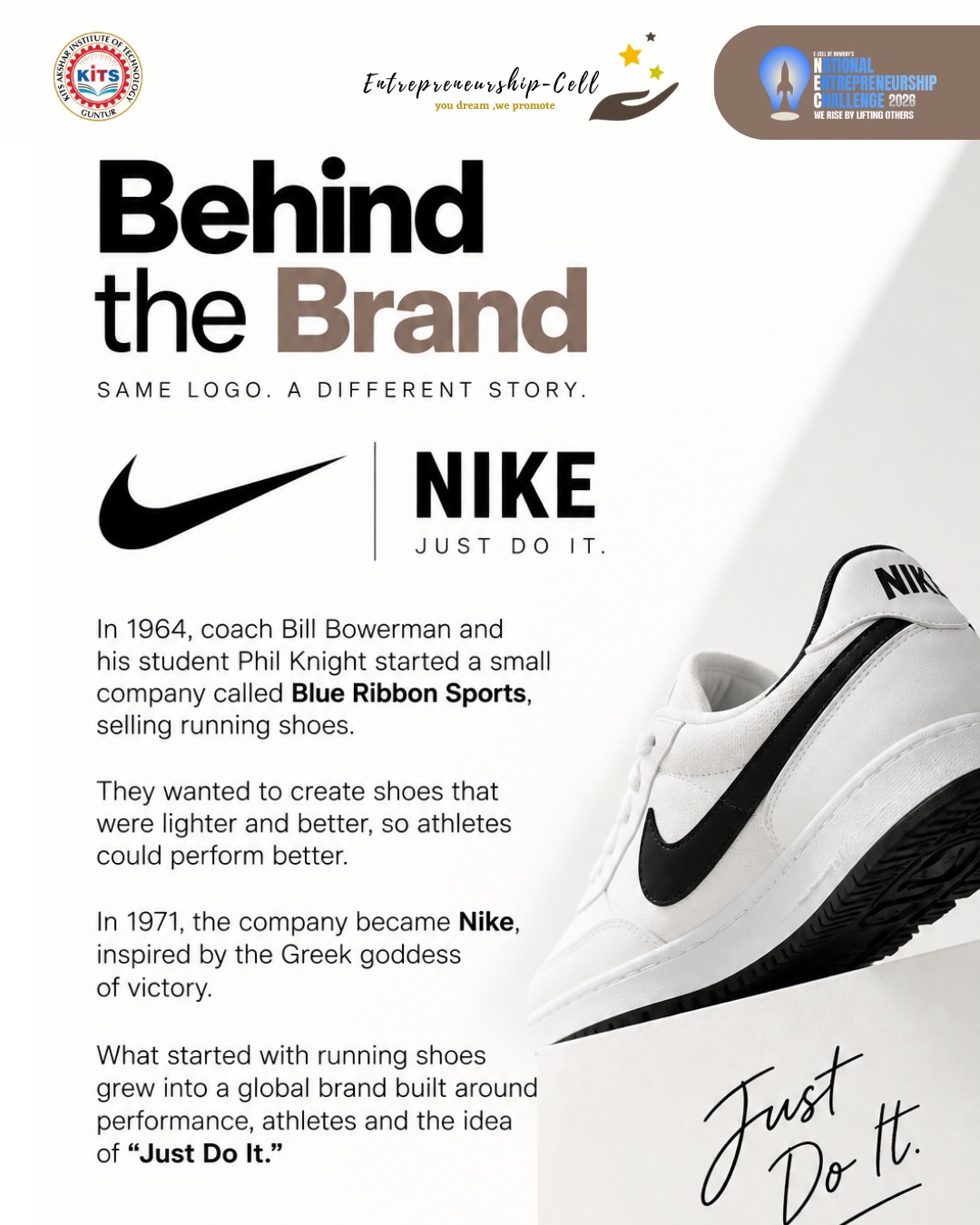 Official Poster
Behind the Brand
Nike
Same Logo. A Different Story.
Not every global empire starts with a grand vision. Sometimes, it starts with a coach
who wanted better shoes for his runners, a student who believed in hustle, and a handshake
deal that launched a revolution in athletic footwear.
The story of Nike is one of relentless innovation, bold branding, and the audacity to
challenge an entire industry. What began as two men selling imported running shoes out of
a car trunk eventually redefined sports, culture, and what it means to "Just Do It."
📍 Oregon, USA (1964)
👥 Phil Knight & Bill Bowerman
💡 From a Car Trunk to a Global Empire
⏱️ 5 Min Read
💡
The Beginning: Blue Ribbon Sports
In 1964, University of Oregon track coach Bill Bowerman and his former student Phil Knight
founded a small company called Blue Ribbon Sports. Their initial idea was
simple — import high-quality, low-cost running shoes from Onitsuka Tiger in Japan and sell
them to American athletes.
Phil Knight sold shoes from the trunk of his car at track meets, while Bowerman experimented
obsessively with shoe designs — even pouring rubber into his wife's waffle iron to create a
lighter, grippier sole.
What started as a side hustle for two passionate runners soon revealed the potential for
something far bigger than reselling imported sneakers.
🚀
From Waffle Irons to the Swoosh
By 1971, the partners decided to create their own brand. They named it Nike,
after the Greek goddess of victory. A graphic design student, Carolyn Davidson, created the
iconic Swoosh logo for just $35 — a symbol that would become one of the most
recognized marks in the world.
Bowerman's relentless experimentation led to revolutionary shoe designs. His "Waffle Trainer"
— inspired by the waffle iron experiment — became one of the best-selling training shoes in
the United States and put Nike on the map as an innovator, not just a reseller.
By the late 1970s, Nike had overtaken Adidas in the U.S. running shoe market and was ready
for its next giant leap.
"Nike's journey proves that innovation doesn't always mean inventing from scratch. Sometimes,
it means looking at a waffle iron and seeing a running shoe — it means daring to reimagine
what already exists."
01
Start with What You Know
Phil Knight and Bill Bowerman didn't start in the shoe business — they started in
running. Their deep understanding of athletes' needs gave them an unfair advantage.
Build from your own expertise and passion.
02
Hustle Before You Scale
Knight sold shoes from a car trunk at track meets. There was no grand launch, no
venture capital — just relentless hustle. Before thinking big, prove your idea works
at the smallest possible scale.
03
Innovate Relentlessly
Bowerman's waffle iron experiment wasn't genius — it was obsession. He ruined
countless prototypes before finding what worked. Innovation requires persistence,
not just inspiration.
04
Build a Brand, Not Just a Product
Nike didn't just sell shoes — they sold a mindset. "Just Do It" became a universal
call to action. Great brands stand for something bigger than what they sell.
05
Bet on People Who Believe in Your Vision
From signing an unknown Michael Jordan to backing Colin Kaepernick, Nike consistently
invested in people who embodied their brand philosophy. Surround yourself with believers
and give them a platform.
For students exploring entrepreneurship, Nike's story is a masterclass in starting lean.
Phil Knight didn't quit his accounting job until Blue Ribbon Sports was already profitable.
He balanced a day job with his startup for years.
You don't need to drop everything to start something meaningful. Begin with your campus,
your community, your network. Sell from a "car trunk" — whether that's a WhatsApp group,
an Instagram page, or a college fest stall.
Bowerman's experiments remind us that the best innovations come from deeply understanding
the people you serve. Talk to your users. Observe their pain points. Then iterate obsessively.
The Nike Swoosh was designed for $35. The waffle sole was born from a kitchen experiment.
World-changing ideas don't need world-class budgets — they need world-class conviction.
Conclusion
Nike's journey from selling imported shoes out of a car trunk to becoming the world's
most valuable sports brand is a testament to the power of passion, persistence, and
bold storytelling.
Phil Knight and Bill Bowerman didn't wait for perfect conditions — they started with what
they had, improved relentlessly, and built a brand that transcended sports to become a
cultural movement.
At the Entrepreneurship Cell, KITS Akshara Engineering College, we believe that every
student has the potential to build something extraordinary — not someday, but today, with
the resources already at hand.
Your Swoosh moment is waiting. Just Do It.
KITS Akshar E-Cell
You Dream. We Promote.
Published by: Entrepreneurship Cell, KITS Akshara Engineering College
Series: Behind the Brand
Featured Brand: Nike
✦
Series: Behind the Brand
Featured Brand: Tesla
Published by Entrepreneurship Cell, KITS Akshara Engineering College
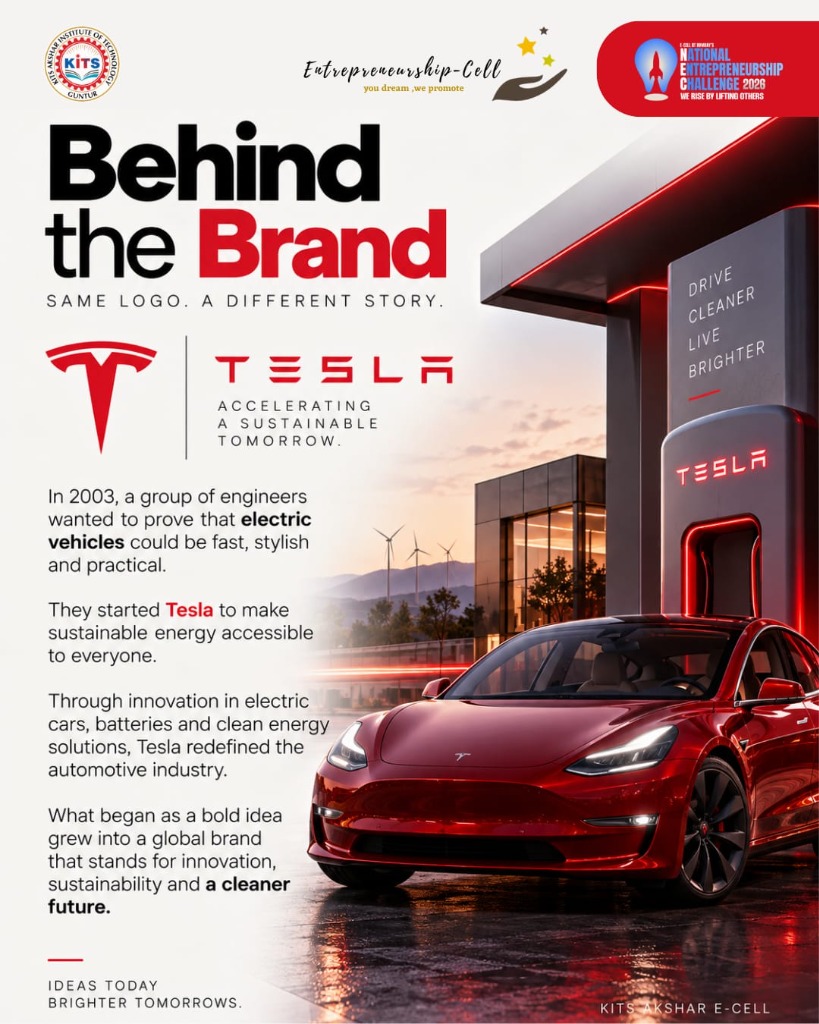 Official Poster
Behind the Brand
Tesla
Same Logo. A Different Story.
In 2003, a group of engineers wanted to prove that electric vehicles could be fast, stylish, and practical.
They started Tesla to make sustainable energy accessible to everyone. Through innovation in electric cars, batteries, and clean energy solutions, Tesla redefined the automotive industry.
📍 Silicon Valley, California (2003)
👥 Martin Eberhard, Marc Tarpenning & Elon Musk
💡 Accelerating a Sustainable Tomorrow
⏱️ 5 Min Read
💡
Challenging the Automotive Status Quo
For decades, electric cars were dismissed as slow, impractical golf carts with limited range. In 2003, Tesla Motors was founded with a radically different thesis: electric power could outperform gasoline engines in every metric.
Instead of building an affordable mass-market car first, Tesla launched the high-performance Roadster to break the stigma around electric vehicles. By targeting sports car enthusiasts first, they proved EV technology was exciting and desirable.
What began as a bold idea grew into a global brand that stands for innovation, sustainability, and a cleaner future.
🚀
Redefining an Industry Through Innovation
Tesla didn't just build electric cars — they built an integrated clean energy ecosystem. From proprietary Supercharger networks and software-over-the-air updates to battery gigafactories and solar energy storage, Tesla reimagined how vehicles are manufactured, sold, and driven.
By open-sourcing their patents and pushing the entire automotive sector toward electrification, Tesla proved that sustainable technology can drive commercial triumph while protecting our planet.
“Tesla's journey shows that true market disruption comes from questioning long-held industry assumptions and proving that clean technology does not require compromising on performance.”
01
Challenge Existing Stereotypes
Electric cars were considered sluggish and boring until Tesla proved they could out-accelerate supercars. Look for industry taboos and test if they still hold true.
02
Top-Down Market Strategy
Tesla started with a high-margin premium product (Roadster) to fund R&D for mass-market vehicles (Model 3 & Model Y). Structure your business roadmap to fund future growth.
03
First-Principles Thinking
Rather than accepting existing battery costs, Tesla broke down battery chemistry to fundamental components and innovated manufacturing to reduce costs exponentially.
04
Build a Complete Ecosystem
Tesla solved customer range anxiety by building its own nationwide Supercharging network. Don't just build a product — solve the friction surrounding its adoption.
05
Mission-Driven Entrepreneurship
Tesla's mission to "accelerate the world's transition to sustainable energy" attracted world-class talent, loyal supporters, and global investor backing through every challenge.
For student engineers and entrepreneurs, Tesla is the ultimate proof that technical excellence combined with bold vision can disrupt legacy industries.
When starting a campus project or hardware startup, don't limit yourself to incremental improvements. Apply first-principles thinking: strip problems down to basic truths and rebuild from scratch.
What began as a bold idea grew into a global brand. Ideas today, brighter tomorrows.
Conclusion
Tesla's transformation from a niche electric sports car maker to the world's most valuable automotive pioneer highlights the power of sustainable innovation and relentless engineering.
What began as a bold idea grew into a global brand that stands for innovation, sustainability, and a cleaner future.
At the Entrepreneurship Cell, KITS Akshara Engineering College, we encourage every student to think boldly and build solutions that lead us toward a brighter, cleaner tomorrow.
Drive cleaner. Live brighter. Accelerating a sustainable tomorrow.
KITS Akshar E-Cell
You Dream. We Promote.
Published by: Entrepreneurship Cell, KITS Akshara Engineering College
Series: Behind the Brand
Featured Brand: Tesla
✦
Series: Behind the Brand
Featured Brand: IndiGo
Published by Entrepreneurship Cell, KITS Akshara Engineering College
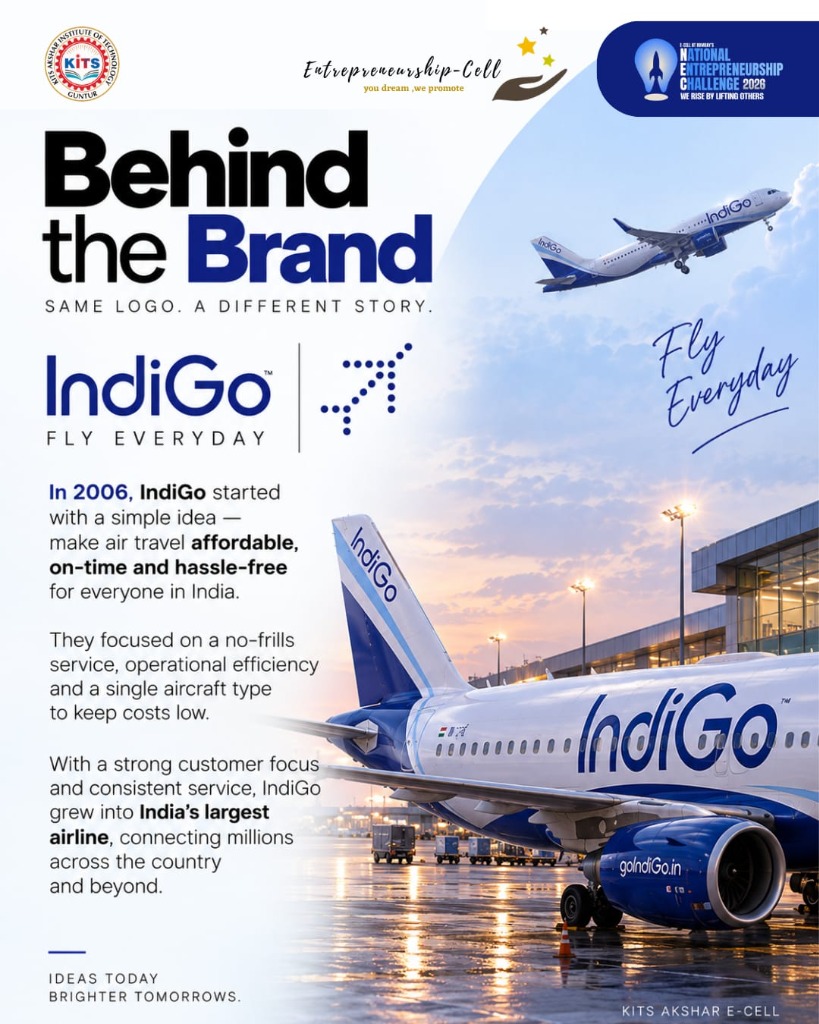 Official Poster
Behind the Brand
IndiGo
Same Logo. A Different Story.
In 2006, IndiGo started with a simple idea — make air travel affordable, on-time and hassle-free for everyone in India.
They focused on a no-frills service, operational efficiency, and a single aircraft type to keep costs low. With a strong customer focus and consistent service, IndiGo grew into India's largest airline, connecting millions across the country and beyond.
📍 Gurugram, India (2006)
👥 Rahul Bhatia & Rakesh Gangwal
💡 Affordable, On-Time & Hassle-Free Air Travel
⏱️ 5 Min Read
💡
The Power of Operational Discipline
When IndiGo entered Indian aviation in 2006, the sector was plagued by high operational costs, delays, and financial turbulence. While competitors focused on luxury lounges and complex fleets, IndiGo made a disciplined choice: focus relentlessly on punctuality, cleanliness, and cost efficiency.
By standardizing on a single aircraft family (Airbus A320), IndiGo drastically cut maintenance, training, and spare parts costs — passing those savings directly to passengers through low fares.
Fly Everyday: A simple promise executed with relentless operational perfection.
🚀
Becoming India's Largest Airline
Through quick turnaround times at airport gates, disciplined fleet expansion, and customer-first processes, IndiGo gained unmatched market share in Indian aviation.
IndiGo proved that consistency beats flashy features. By keeping their core promise — affordable fares, on-time departures, and courteous service — they won the trust of millions of first-time and frequent flyers alike.
“IndiGo's story proves that business success doesn't always come from doing more things — it comes from doing key operational things better, faster, and more consistently than anyone else.”
01
Laser Focus on Core Value proposition
IndiGo identified what Indian passengers cared about most: low fares and on-time performance. They eliminated unnecessary extras to deliver on what truly mattered.
02
Standardization Drives Scale
Operating one type of aircraft simplified crew training, maintenance, and flight scheduling. Standardizing operations lowers unit costs as you scale.
03
Turnaround Speed as a Competitive Advantage
Planes only make money when they are in the air. IndiGo perfected 25-minute gate turnarounds to maximize aircraft utilization every single day.
04
Customer Trust Built Through Reliability
Consistency creates loyalty. By systematically prioritizing punctuality and clean service, IndiGo became the most trusted airline for business and leisure travel.
05
Prudent Financial Management in Tough Markets
Through sale-and-leaseback aircraft deals and lean overhead, IndiGo built a fortress balance sheet capable of navigating aviation economic cycles.
For student founders, IndiGo provides a blueprint for building lean, execution-focused startups.
You don't need excessive features or complex offerings to win. Master one core pain point, execute it flawlessly every day, and optimize your operations for maximum efficiency.
With a strong customer focus and consistent service, IndiGo grew into India's largest airline. Operational excellence is your competitive moat.
Conclusion
IndiGo's journey from a bold startup concept in 2006 to India's dominant aviation leader demonstrates the power of simplicity, discipline, and customer-centric execution.
Their story reminds us that great companies are built on consistency, execution quality, and keeping the promises made to customers every single day.
At the Entrepreneurship Cell, KITS Akshara Engineering College, we empower students to transform simple, powerful ideas into scalable ventures through operational discipline.
Fly everyday. Ideas today, brighter tomorrows.
KITS Akshar E-Cell
You Dream. We Promote.
Published by: Entrepreneurship Cell, KITS Akshara Engineering College
Series: Behind the Brand
Featured Brand: IndiGo

Community & Insights
Comments (3)
Share your takeaways, thoughts, or questions on this article.